|
Fact 4: PLM Improves Response to Business Pressures
|
|
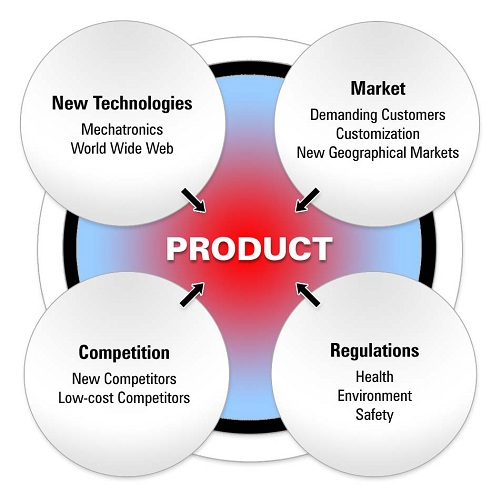
PLM enables companies to more easily respond to business and market pressures, including
competitors, customers, globalization, regulatory compliance or shareholders.
|
|
There are many reasons for the emergence of PLM. Some of these are technology-based. Some are
market-based. Some are a response to opportunities. But a majority of reasons are a response to pressure.
The most basic pressure is that companies need to make more money - even though they face more
competition. Unless they distribute money to shareholders, employees and suppliers they will go out of
business. This 'bottom-line' need is the fundamental business reason for PLM.
|
| There are also macro-economic reasons for PLM to include globalization, increased competition,
outsourcing and the resulting need and opportunity for collaborative product development. Other reasons
relate to changes in customer behavior, such as a desire for customized products and concerns about the
environment.
|
 |
|
Some reasons relate to changes in society such as increased regulatory requirements, product traceability
and Sustainable Development. For example, European directives regarding vehicle 'end of life' put
responsibility on manufacturers to dispose of vehicles in an environmentally sensitive way. This can only
be effective if all components are traceable and information is available on materials used.
|
| Globalization gives companies the opportunity to find new customers and increase sales worldwide, but it
also means they have to face competitors all over the world. Increased competition means they have to be
more innovative, develop better products, develop them faster and develop them at lower cost.
|
| Globalization also means they have to be close to customers, understand customer requirements and sell
products in many places. They have to coordinate the launch of new and modified products for the global
marketplace. They have to provide technical information, parts, products and service in many locations -
and meet regulations in many countries.
|
| The increasing complexity of products pushes companies towards PLM as a way to manage products
more effectively, especially 'mechatronic' products - products that contain a mixture of mechanical,
electrical, electronic and software modules. They are faced with issues such as managing huge volumes of
data, supporting products with lives longer than those of IT applications, an increasing amount of
software and electronics in their products, and the changing geographical location of product development
skills.
|
| Technology advances also pull PLM. Airfreight enables the rapid transport of designs, parts and goods to
customers worldwide. The Internet and the World Wide Web enable information to be transferred even
faster. Improved communications offer the opportunity to be closer to customers and suppliers. New
Information Systems allow companies to work more effectively internally and, externally, to get closer to
customers and suppliers. Database management systems manage product data distributed on multiple sites
around the world. The Web and Internet provide ways to allow many activities to be carried out faster
and/or at lower cost. Engineering drawings can be sent by e-mail. Product requirements can be collected
through questionnaires on the Web. Products can be configured and ordered on the Web.
|