PLM is what your company does everyday to manage products through their lifecycles - but in a more
automated, joined-up and streamlined fashion for even greater benefit.
Any discussion on Product Lifecycle Management (PLM) needs to begin with what the product lifecycle
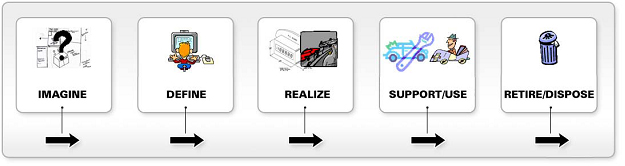
actually is. Regardless of the type product you produce, it likely goes through five distinct periods or
product phases during its life: imagination; definition; realization; support; and retirement. So therefore,
managing a product throughout its lifecycle means managing a product:
When it is an idea (e.g., making sure the product idea doesn't get lost)
When it is being defined (e.g., making sure that the development project meets its objectives)
When it is being realized (e.g., making sure the correct version of the definition is used during
production)
When it is in use (e.g., making sure it is correctly maintained, taking account of its serial number,
production date, previous upgrades, technical evolution, etc.)
When it is being disposed of (e.g., making sure poisonous components don't get anywhere near
sources of drinking water)
Of course, companies have always in some way performed product lifecycle management but not
necessarily in the most cohesive way. For example, product development and product support were often
carried out in different parts of the organization even though they addressed the same products. The way
that products were managed throughout the lifecycle was not proactively addressed by company
management, not planned, not documented.
Sometimes, products were managed in one way in early stages of the life, then in a different way during
their development. Often companies didn't manage the product during its use. Sometimes they managed
the product again when the product was due for disposal, sometimes it didn't. Some managers made sure
that products were sold, making money for shareholders, and enabling employees and suppliers to be
paid. And in other parts of the organization, other managers made sure that new products were developed
and brought to market. Various elements of PLM were being addressed departmentally.
At different times, products were managed in different ways with different approaches, processes and
applications, such as Product Portfolio Management (PPM), New Product Introduction (NPI), Product
Data Management (PDM), Configuration Management (CM), Product Recall, Customer Complaint
Management, Product Warranty Management, and Engineering Change Management. The individual
approaches each had their own processes, applications, documents, etc. Having different approaches led to duplicate data and conflicting data.
Some of the various applications used to manage products 'talked' to each other - others didn't, with the
interfaces sometimes difficult to define and manage. As a result, things sometimes slipped though the
gaps. At other times, resources got held up in places such as departmental data silos, communication sinks
and islands of automation. Information was lost, misunderstood or ignored. the Risks and results weren't
fully analyzed and decisions were made on the basis of incomplete data.
Costs increased, time was wasted and quality issues arose, resulting in problems ranging from failure to
meet customer requirements and late time to market, to product recalls and inadequate customer service,
and worse yet, to damages due to product use and product-related deaths.
The New PLM is Holistic and Joined-up
The 'new' PLM we will discuss in this white paper is just the opposite of the old approach. It is clearly defined, well-documented and pro-active, taking place according to a particular design to meet a particular objective.
Unlike its predecessor, some of the most important characteristics of the new PLM are that it is holistic
and 'joined-up'. What we mean by holistic is that PLM addresses all of the important components of a
product from the product itself, to product data and documents, processes, applications, methods,
equipment, people, organizational structure, and metrics (including costs and revenues). By joined-up we
mean that the new PLM links many previously separate and independent processes, disciplines, functions
and applications - each of which, though addressing the same product, had its own vocabulary, rules,
culture and language. It brings together what was previously separate - for example, Product
Development and Product Support. So Product Support can have input earlier in the development of a
product and Development can see past records of customer issues to help them steer new products'
designs away from repeating past mistakes.